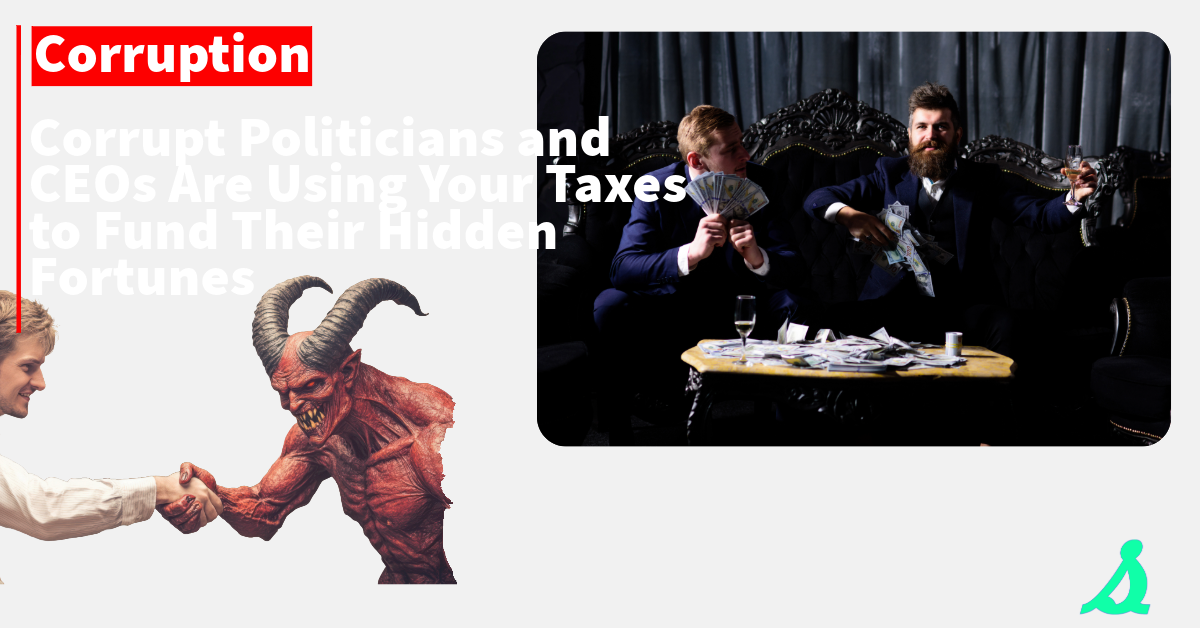
How Corrupt Politicians and CEOs Drain Your Taxes

Not financial advice — educational only.
Every year, a slice of the money you hand over in taxes never reaches the schools, roads, or hospitals it was meant for. Instead it disappears into shell companies, padded contracts, and offshore accounts controlled by the very officials and executives who were supposed to spend it wisely. Corruption is not a distant problem for "other countries" — it is a measurable drain on public budgets everywhere, and ordinary taxpayers foot the bill.
This piece walks through how the money actually moves, what the latest data says about the scale of the problem in 2026, and the reforms that have a track record of working. The goal is not outrage for its own sake — it is to help you see the mechanics clearly enough to spot them.
How the Money Actually Moves
Grand corruption rarely looks like a suitcase of cash. It is usually paperwork — legal-looking contracts, invoices, and transfers that each pass an individual smell test but add up to theft. A few recurring mechanisms do most of the work.
Inflated public contracts and kickbacks
Public procurement is the single largest corruption risk in most governments. An agency awards a road or defense contract at an inflated price; the winning firm quietly returns a percentage to the officials who steered the deal. The gap between the fair price and the inflated one is pure taxpayer loss. Brazil's decade-long Lava Jato (Operation Car Wash) investigation, centered on the state oil company Petrobras, exposed exactly this pattern on a multibillion-dollar scale.
Shell companies and offshore accounts
Once money is skimmed, it has to be hidden. Anonymous shell companies registered in low-transparency jurisdictions let the true owner stay invisible while the cash is layered through bank accounts and property. The 2016 Panama Papers and the 2021 Pandora Papers, both published by the International Consortium of Investigative Journalists, documented how heads of state and business elites used these structures to move and conceal wealth.
Diverted aid and emergency funds
Money that flows fast and with weak oversight — disaster relief, development aid, pandemic stimulus — is unusually easy to divert through fake projects or ghost suppliers. The speed that makes emergency spending useful is the same speed that makes it vulnerable.
The Scale of the Problem in 2026
Corruption is hard to measure precisely — that is part of its design — but the best available estimates are sobering. The World Economic Forum has long put the global cost of corruption at at least 5% of global GDP, and the World Bank estimates that more than $1 trillion is paid in bribes every year.
The direction of travel is not encouraging. Transparency International's 2025 Corruption Perceptions Index found the global average score stuck at 42 out of 100, with 122 countries scoring below 50 — the threshold that signals serious public-sector corruption. Only five countries now score above 80, down from twelve a decade ago. In other words, the perceived integrity of governments has been sliding, not improving.
Key takeaways
- Grand corruption usually runs through legal-looking paperwork: inflated contracts, shell companies, and offshore accounts — not cash in envelopes.
- The World Economic Forum estimates corruption costs at least 5% of global GDP; the World Bank puts annual bribes above $1 trillion.
- Transparency International's 2025 index shows 122 of 180 countries scoring below 50, with integrity broadly declining.
- The bill lands on ordinary taxpayers as worse public services and higher effective tax burdens.
- Transparency reforms — beneficial-ownership registers, open contracting, and protected whistleblowers — have a real track record.
Why It Lands on You
When revenue leaks, governments face a simple arithmetic problem: cut services, borrow more, or raise taxes. All three fall hardest on people without accountants and lobbyists. Underfunded clinics and schools, potholed infrastructure, and rising fees are the visible face of money that was quietly redirected. For most households the squeeze shows up in the fixed, unavoidable costs of daily life — the kind of inflexible expenses that leave the least room to absorb a shock.
There is also a compounding effect. Corruption deters honest investment, misallocates capital toward whoever pays the biggest bribe rather than whoever builds the best project, and erodes the public trust that functioning institutions depend on. Each of those makes an economy grow more slowly, which shrinks the tax base further.
What Actually Works Against It
Corruption is entrenched but not invincible. The countries that score best on integrity tend to share a handful of concrete, unglamorous features.
Beneficial-ownership transparency
Anonymous companies are the getaway car of financial crime. Public registers that name the real human owners of companies make it far harder to hide stolen money. Momentum has grown here since the Panama Papers, though enforcement remains uneven across jurisdictions.
Open contracting and audits
Publishing procurement data in a standard, searchable format lets journalists, rivals, and citizens spot inflated or single-bidder contracts before the money is gone. Independent audit bodies with real teeth close the loop.
Protected whistleblowers and a free press
Nearly every major scandal of the last decade surfaced because an insider leaked and journalists dug. Strong legal protection for whistleblowers, and a press free to publish, are among the most cost-effective anti-corruption tools that exist.
Following the money across borders
Because stolen funds cross borders, recovery requires cooperation between financial-intelligence units, banks, and prosecutors in multiple countries. Asset-recovery frameworks that actually return money to the country it was stolen from are slowly improving, but remain the weakest link.
The Bottom Line
Corruption is not an unavoidable weather system. It is a set of specific, repeatable techniques that thrive on secrecy and die under scrutiny. The tools that shrink it — transparency, independent oversight, protected whistleblowers, and cross-border cooperation — are well understood. The hard part is political will, and that is where informed, persistent citizens actually matter. Knowing how the money moves is the first step to noticing when it goes missing.
Frequently Asked Questions
What is the difference between tax evasion and corruption?
Tax evasion is illegally not paying taxes you owe. Corruption is the abuse of entrusted power — public or corporate — for private gain, which often includes stealing tax revenue after it has been collected. They frequently overlap: stolen public funds are commonly hidden using the same offshore structures used to evade taxes.
How much does corruption really cost?
Estimates vary because the activity is hidden by design. The most-cited figures come from the World Economic Forum (at least 5% of global GDP) and the World Bank (more than $1 trillion in bribes annually). Treat these as informed order-of-magnitude estimates rather than precise accounting.
What does the Corruption Perceptions Index measure?
Transparency International's index scores 180 countries from 0 (highly corrupt) to 100 (very clean) based on expert and business surveys of perceived public-sector corruption. The 2025 edition put the global average at 42, with most countries below the 50 mark.
Have the big leaks actually changed anything?
Partly. The Panama and Pandora Papers triggered resignations, investigations, and new beneficial-ownership rules in several countries. But enforcement is inconsistent, and new secrecy channels open as old ones close — which is why sustained transparency matters more than any single exposé.
What can an ordinary person do about it?
Support transparency in public spending, back independent journalism and whistleblower protections, and pay attention to how procurement and budgets work in your own city or country. Corruption depends on nobody looking; attention raises its cost.
This article is for general education only and is not financial, legal, or tax advice.